Skip to content

Posts from the ‘Mischief Managed’ Category

MD Watershed Implementation Plan

MDE release – http://www.mde.state.md.us/Pages/Home.aspx

The Chesapeake Bay TMDL, Maryland’s Watershed Implementation Plan and Maryland’s 2012-2013 Milestone Goals

DRAFT Phase II Watershed Implementation Plan for Public Review (January 26, 2012)

The Chesapeake Bay is a national treasure constituting the largest estuary in the United States and one of the largest and most biologically productive estuaries in the world.  Despite significant efforts by federal, state, and local governments and other interested parties, pollution in the Chesapeake Bay prevents the attainment of existing water quality standards.  The pollutants that are largely responsible for impairment of the Bay are nutrients, in the form of nitrogen and phosphorus, and sediment.

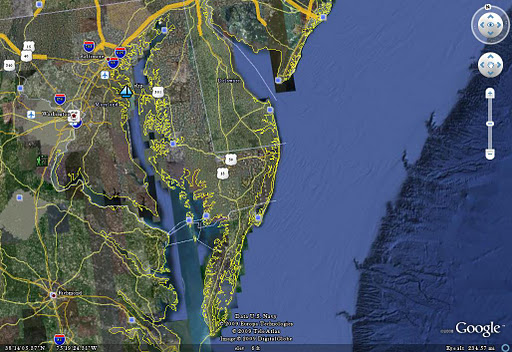
The United States Environmental Protection Agency (EPA), in coordination with the Bay watershed jurisdictions of Maryland, Virginia, Pennsylvania, Delaware, West Virginia, New York, and the District of Columbia (DC), developed and, on December 29, 2010, established a nutrient and sediment pollution diet for the Bay, consistent with Clean Water Act requirements, to guide and assist Chesapeake Bay restoration efforts.  This pollution diet is known as the Chesapeake Bay Total Maximum Daily Load (TMDL), or Bay TMDL.   MDE took part in an ongoing, high-level decision-making process to create the essential framework for this complex, multi-jurisdictional TMDL that will address nutrient and sediment impairments throughout the entire 64,000 square mile Chesapeake Bay watershed.

MDE participated in numerous inter-jurisdictional and inter-agency workgroups and committees over the last three years to provide technical expertise and guidance for developing the Bay TMDL in a manner consistent with the State’s water quality goals and responsibilities. In particular, MDE worked to ensure that the Bay TMDL addressed the nutrient and sediment impairments in all of Maryland’s tidal waters listed as impaired by those pollutants on the State’s Integrated Report of Surface Water Quality.

MDE took the lead on developing an allocation process that will enable the State to meet a key requirement for the Bay TMDL and Maryland’s Watershed Implementation Plan:  the sub-allocation of major basin loading caps of nutrient and sediment to each of 58 “segment-sheds” in Maryland – the land areas that drain to each impaired Bay water quality segment – and to each pollutant source sector in those areas.

RBFF notes ICW Fishing opportunities

The Recreational Boating and Fishing Foundation is a great non-profit organization whose mission is to incease participation in recreational angling and boating and thereby increase public awareness and appreciation of the need to potect, conserve and restore this Nation;s aquatic natural resources.

They provide a valuable service to the boating and fishing communities…….. the following article is from their web site  at http://www.takemefishing.org/general/about-rbff — take a tlook for more great info!

The Intracoastal Waterways – An angler’s paradise

Whether you’re a newcomer to saltwater fishing or a seasoned pro, the ICW offers some of the most accessible and enjoyable light tackle action in the country.

The Intracoastal Waterway (ICW) is comprised of various bays, inlets, saltwater rivers and other manmade water canals that offer boat passage and protection from the open sea. There are three separate ICW regions: the Gulf of Mexico ICW stretches from south Texas to the panhandle of Florida, the Florida Gulf Coast ICW connects Tarpon Springs to Ft. Myers, and the Atlantic ICW reaches from the Florida Keys all the way to Virginia.

ICW waters are typically calmer, and readily accessible to smaller recreational fishing boats. They’re also home to prolific schools of baitfish, as well as larger sport fish that migrate, feed, and breed there. Indeed, the ICW is the ultimate “inshore” fishery in America.

Here are some ICW fishing hotspots worth checking out with light tackle.

  • Laguna Madre in Texas – A massive hyper-saline (and consistently shallow) lagoon, the Laguna Madre is a veritable factory for speckled sea trout, as well as redfish and tarpon.  If sight fishing is your deal, this is a place where you can run a skiff, wade or kayak for miles, and cast at fish all day.
  • Carrabelle, Florida – Fishing guides from throughout the region gravitate toward the waters around Carrabelle in the summer, because big tarpon migrate there. In the fall, the sea trout action is hot.
  • Fort Myers, Florida – Try fishing for snook in the evening from a flats skiff in the boat canals. Fly fishing is a particularly rewarding approach; use a purple “Puglisi Peanut Butter” fly with an 8-weight rod.
  • Miami Beach, Florida – Believe it or not, anglers have been known to hook 100-pound plus tarpon by casting plugs (and flies) in and around Governor’s Cut, right where the cruise ships pass by. It’s also fun to catch pompano in this area. But be sure to pay attention to other boat traffic when fishing here.
  • St. John’s River, Florida – Northeast Florida has a wide array of canals, rivers and channels that are loaded with some of the best populations of sea trout, jacks and redfish in the country. This is a kayak fisherman’s paradise.
  • Hatteras, North Carolina – Fishing on the inside of the Outer Banks offers some of the best opportunities to chase redfish in shallow water. Try slowly retrieving a golden spoon with a light- or medium-action spinning rod.

The number of species from striped bass to snapper, black drum to sheepshead (and everything else mentioned above) comprises only a fraction of a list longer than any angler can tackle in a lifetime. And the approaches and techniques you can use are only limited to your imagination. So what are you waiting for? Give it a try.

Imagine clean waters

If I have your attention – come on back for observations and views about current conservation issues as this site grows.

What to do with winter……

Clearly there are all sorts of things to do, especially withholiday business behind us. Shovel snow for one if you live in that part of theworld. Cut, split and stack wood for the wood stove or fireplace.  As they say, it warms twice. I can attest tothat from personal experience. Do those chores around the house that got putoff during the important (sailing) season – and explain at home why that’s so.The explaining could be a serious time sink depending on the views of others inthe household. I’m sure you can add to this short list with many imaginativetasks from your – and others’- to do lists. However, I’m inclined to be forwardlooking, and specifically to look past this current inconvenient weather. Afterall, it is only a few short weeks till Spring sailing weather.

Days are gettinglonger now, and the pace of that change will accelerate soon. We’ve turned thecorner on day length, and very soon will do the same with temperatures.

So, on a more positive note I’m planning and preparing forthe return of the important season. That means attending to all the boat tasks– repairs and improvements – that didn’t get done when being on the water wasmore compelling. It’s actually very satisfying to complete those jobs that havebeen nagging at you for several months. In fairly short order:

  • I managed torepair some seams on my dodger and bimini – and learned another skill in theprocess.

  • Re-assembled the bimini framework and began acquiring the parts neededto add supports in anticipation of installing a solar panel or two on top.

  • Built a more convenient companionway door (well almost done).

  • Washed dockingand other extra lines that laid in the locker most of the past season.

Yet tobe accomplished is adding chain and new rode to anchors, add a new anchor toinventory and finish construction of ‘glass’ side panels to enclose the cockpiton those inclement days.

To add challenge and excitement to this off-season process, Ihave been mapping out my season schedule, noting organized club event and othersailing opportunities on my Outlook calendar. Of greater interest is pouringover charts to plan more extended cruising to new places and imagining findingquiet anchorages yet to be visited. Already I have at least two 10-day trips onthe calendar, as well as preparations for heading south next Fall before allthis cold weather arrives again. That will make my next winter “to do list”quite different!

Between chores it is a delight to follow the travels of sailing friends who allow us to track their progress via SPOT trackers, and to livevicariously thru their frequent Blog posts with pictures and descriptions ofplaces, events and the occasional interruptions of groundings and other minormishaps. Here’s one example of a friend who left Portland, ME last October andis now in north Florida —  http://forums.sbo.sailboatowners.com/forumdisplay.php?f=142

There’s much to belearned from those who are going places you have not been but intend to go. So,productive time is spent absorbing that experience and weaving it into our owncruise planning.

Finally, and not the least of opportunities, are all theseminars and other activities offered by clubs and the sailing industry. And Ijust heard we will have a Spring boat show in Annapolis (April) to add to theearly season fun – and wreak havoc with our boat budgets.

So, get busy with thechores, and look forward to seeing you on the water soon!

BTW – Happy Friday the 13th!

Come on along!

Welcome to Chesapeaketidings… a place to find stories about our adventures sailing on the Chesapeake Bay and other wanderings.   You will also find news and views about conservation issues, and my occasional musings about current events, natural resource policy matters and other miscellaneous issues of interest.

Till Spring…….

Winter always feels ‘bare’ … trees have lost their foliage, boats are soon striped of canvass and sails, and snow lurks around the corner………

enjoy the quiet time, have a great holiday season and we’ll see you in the Spring!

Lighting up Christmas!

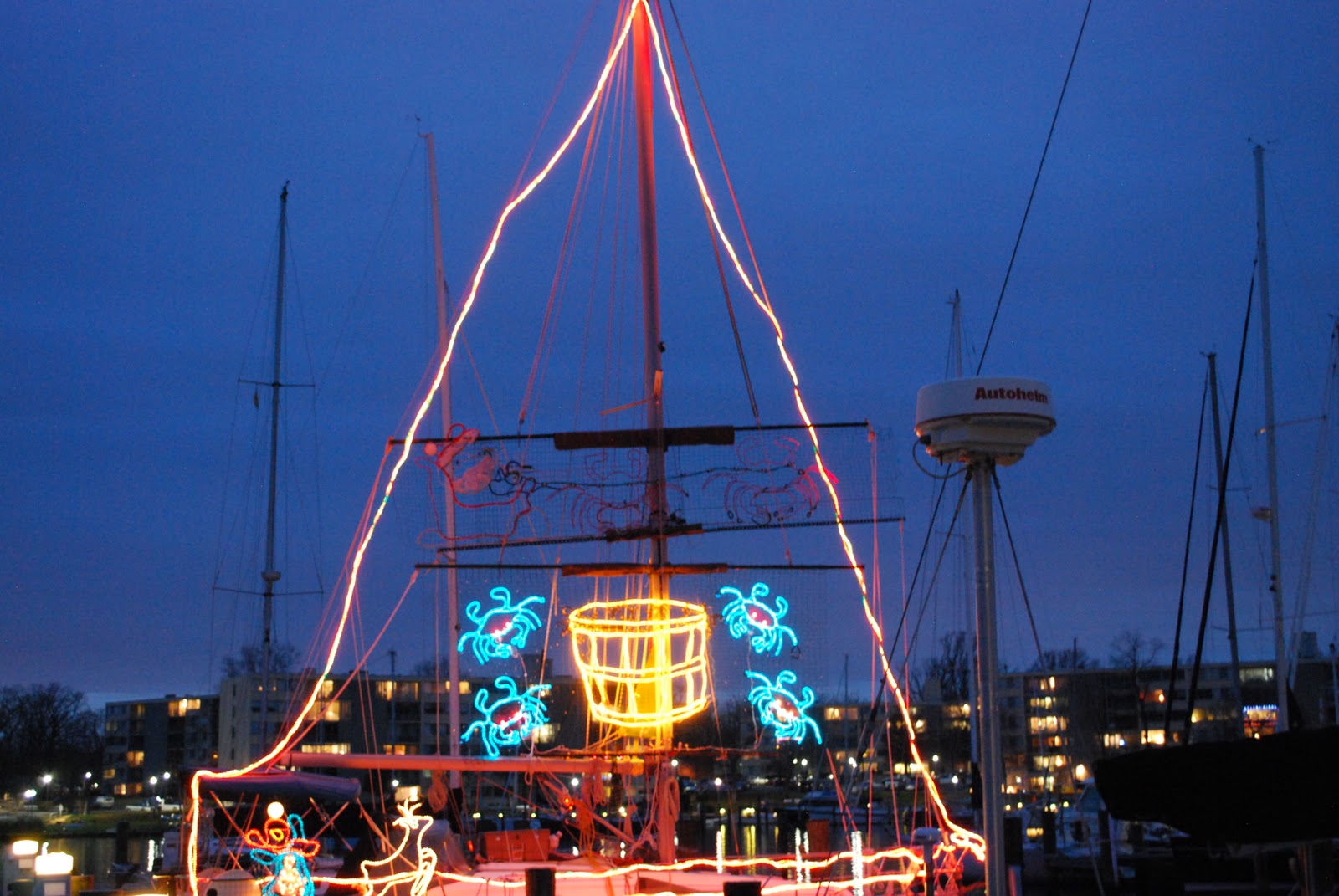
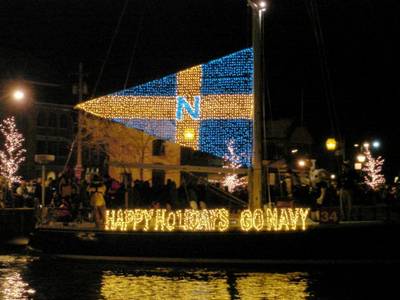
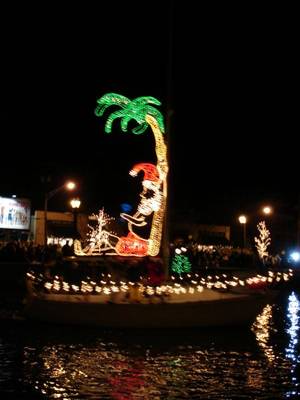
As Christmas approaches, preparations for theannual Annapolis Parade of Lights are well underway. This annual evening eventin Spa Creek attracts over two dozen boats both power and sail, each with elaborate Christmas themedecorations presented in multicolored lights. Boats circle Spa Creek above andbelow the bridge linking Annapolis to Eastport. The bridge and other areas witha view of the creek are filled with folks who brave the usually cold evening toenjoy the colorful boats.
Many boating clubs enter their best designs to compete for prized titles. Singles on Sailboats (SOS) has entered each year for 15 years, and received prizes in many of those years.

 Lest you think this is a simple undetaking and just means stringling some lights on a boat – here’s a brief look at the preparations required.


First, someone conceives of a novel design (with all the engineering and electrical considerations) and prepares full scale drawings. Frank Florentine, a professonal lighting engineer and SOS member, provides these volunteer services.

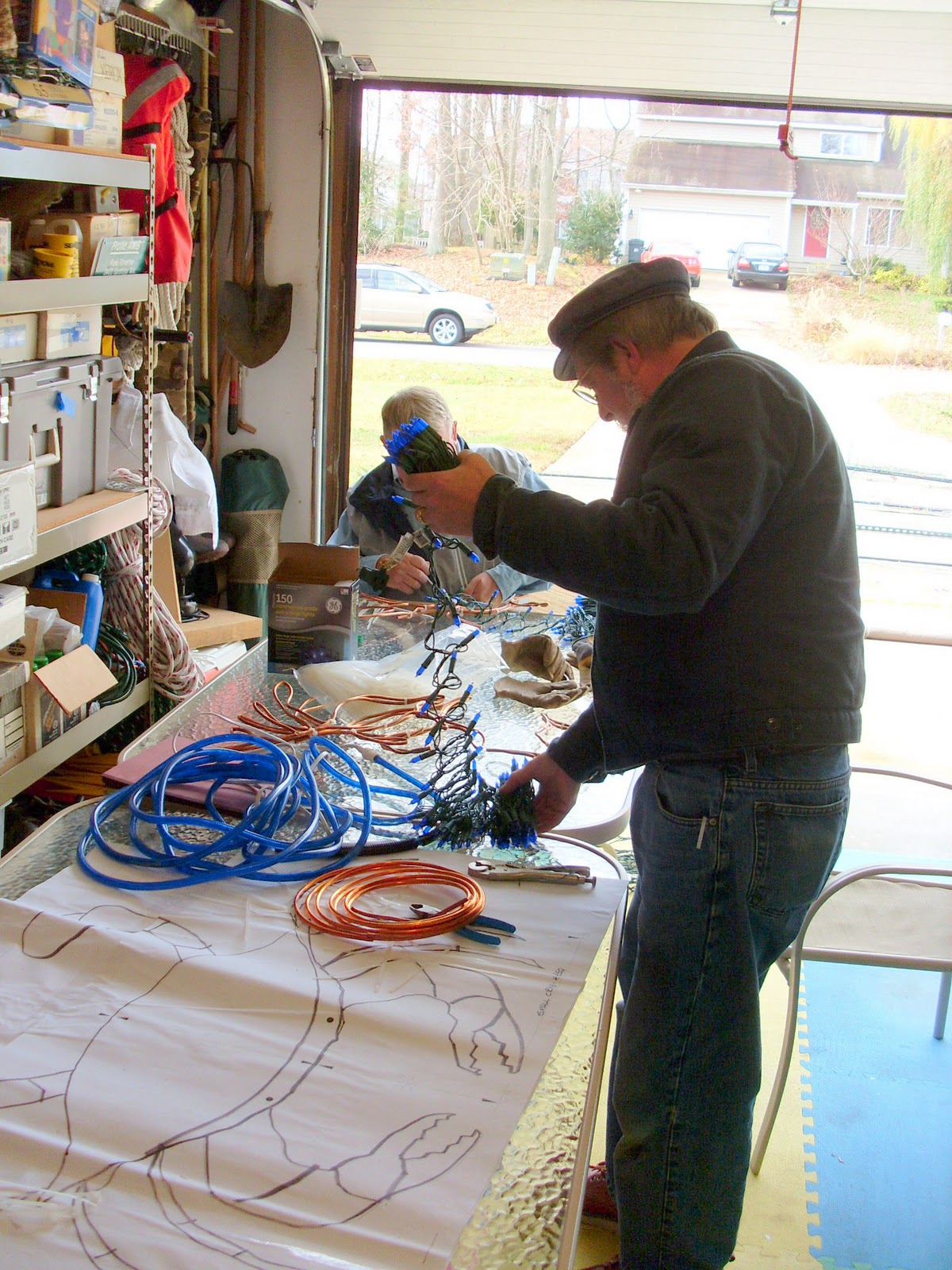
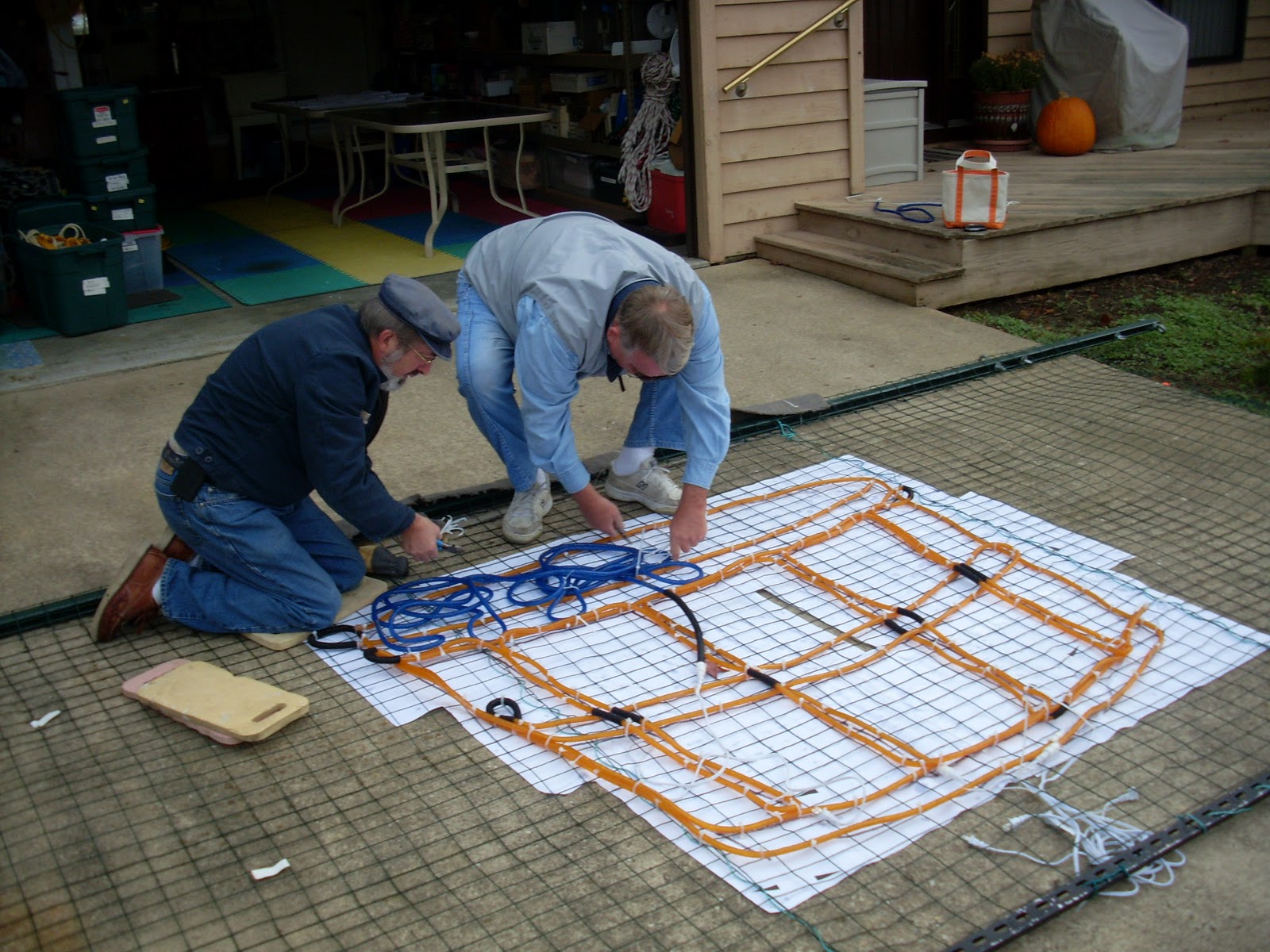
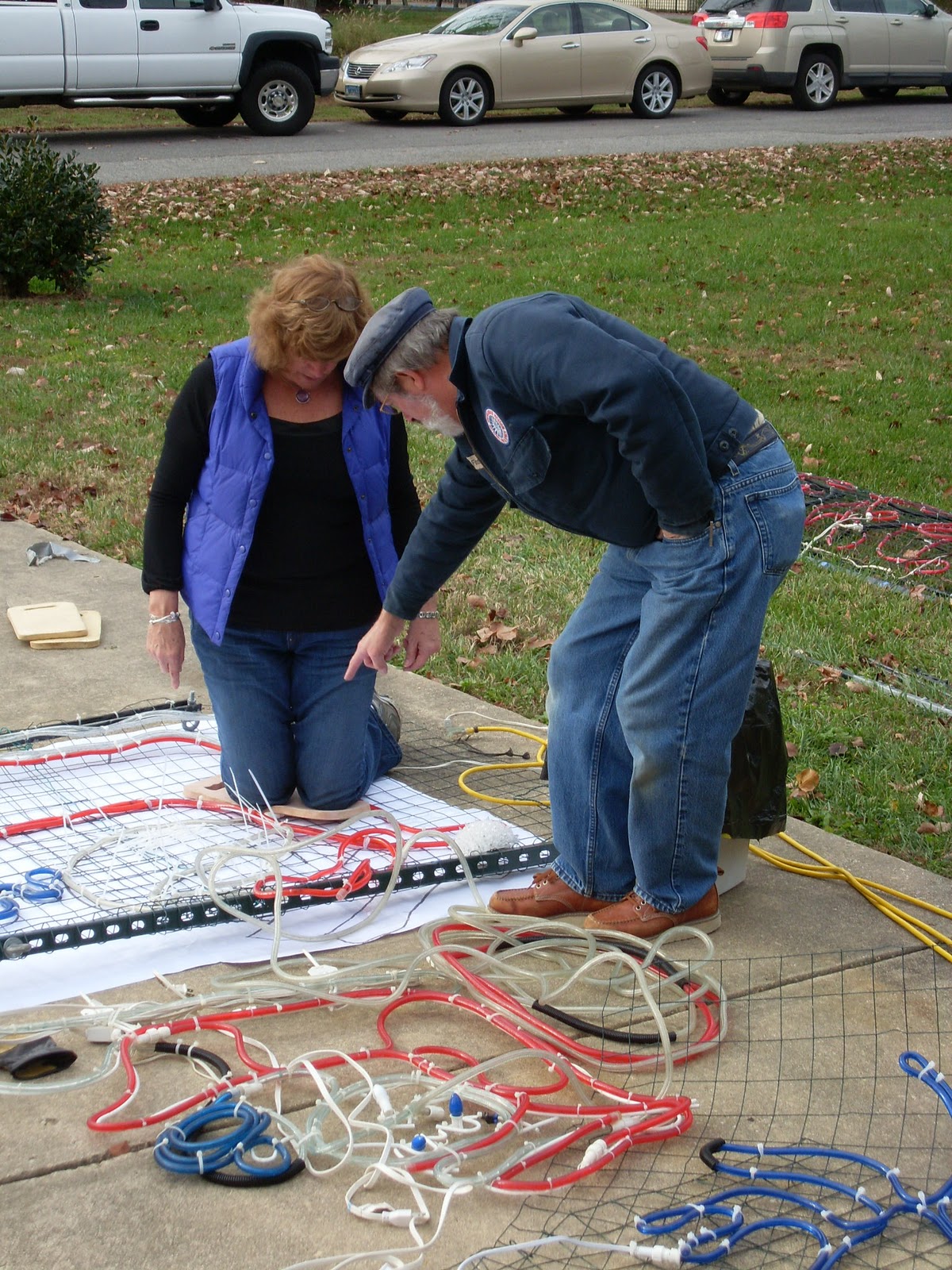
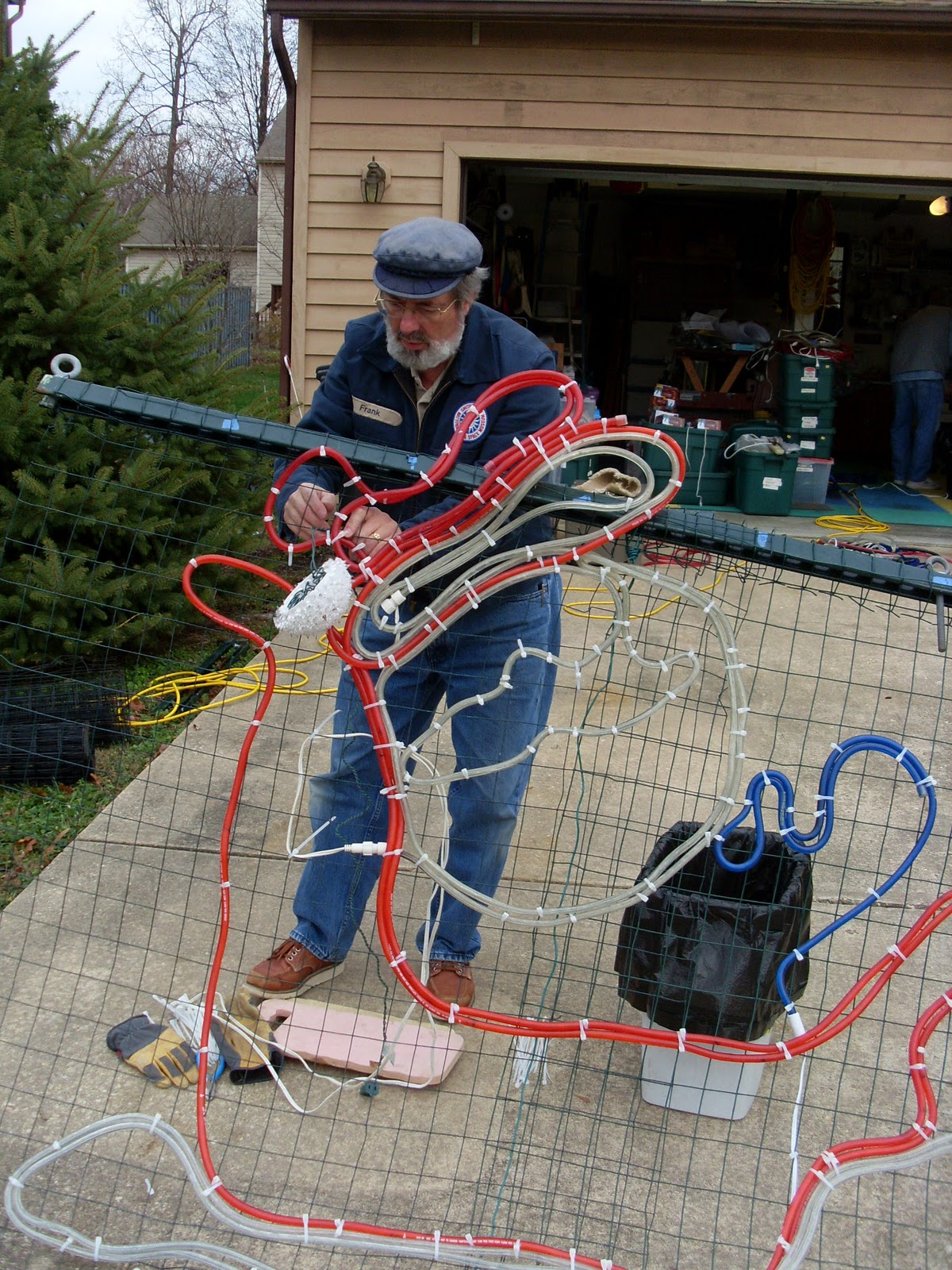
All the light strings, tie wraps, wire mesh, extension cords etcare hauled from storage and last year’s designs dismantled. Wire mesh is laid over the new drawings and lightstrings are tied on to outline the designs.
Pictures begin to take shape and come alive aslights are tested.
All the work is done under the direction andwatchful eye of our designer/engineer Frank.
Light strings are checked to besure they’re in working order, and the representation of the design materializes as planned.

When all is completed, it gets hauled to theboat and rigging begins to safely raise the completed designs up the mast andattached wherever else is needed….

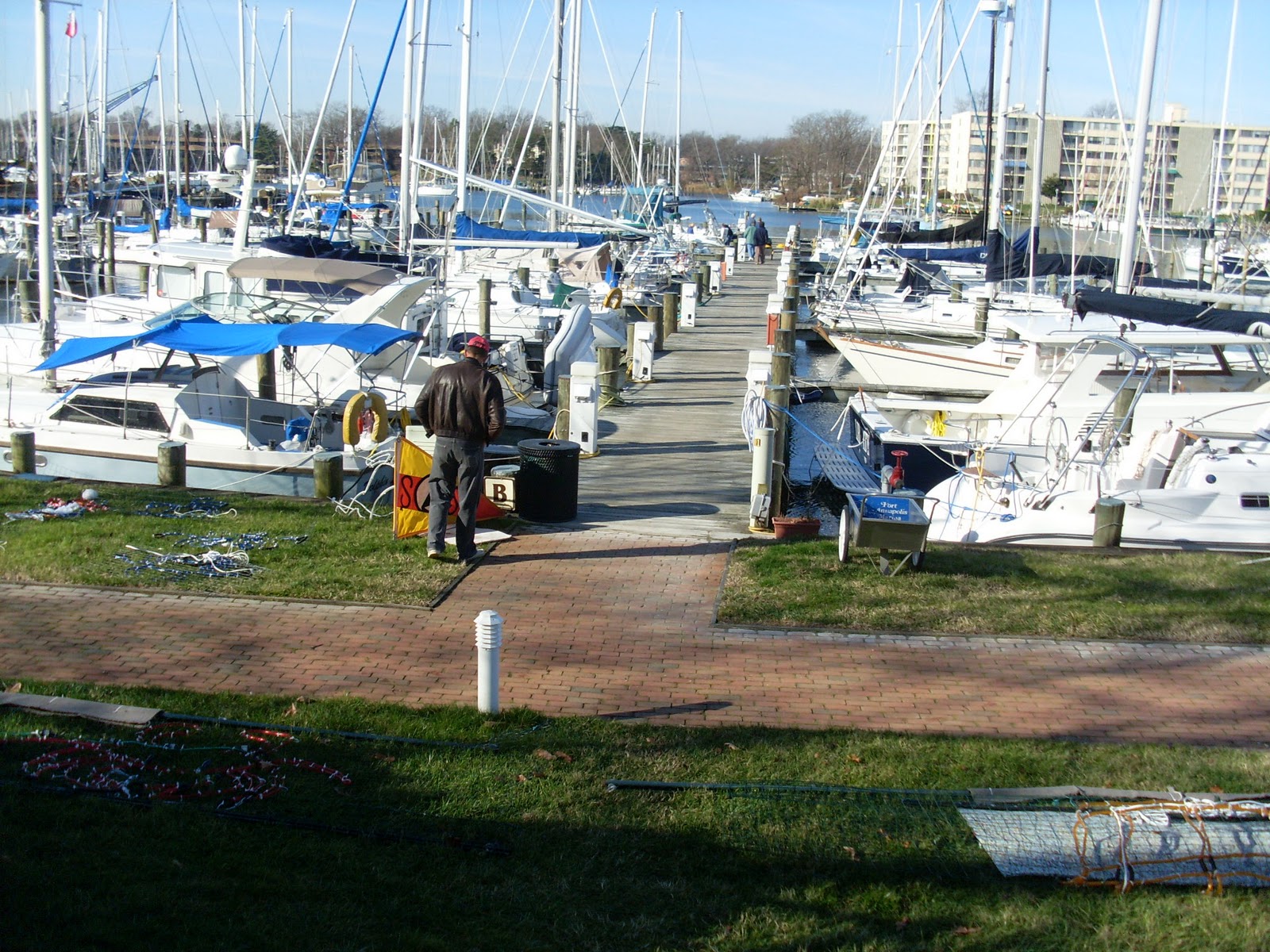
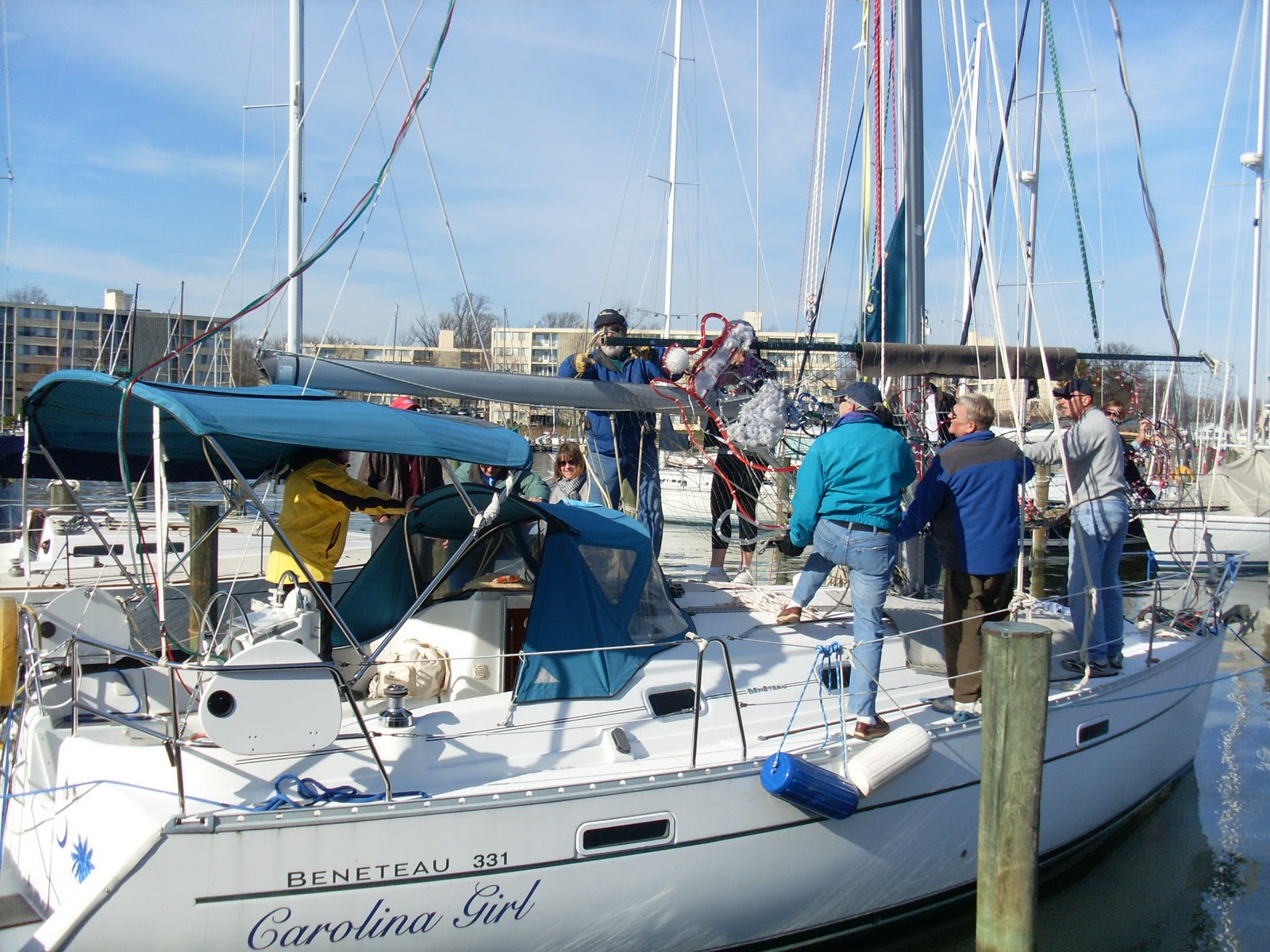
 …..starting with hauling it all from the truck out the length of the dock to ‘Carolina Girl’, Christi Tinnes’ 31ft Beneteau that she volunteers for this event each year…

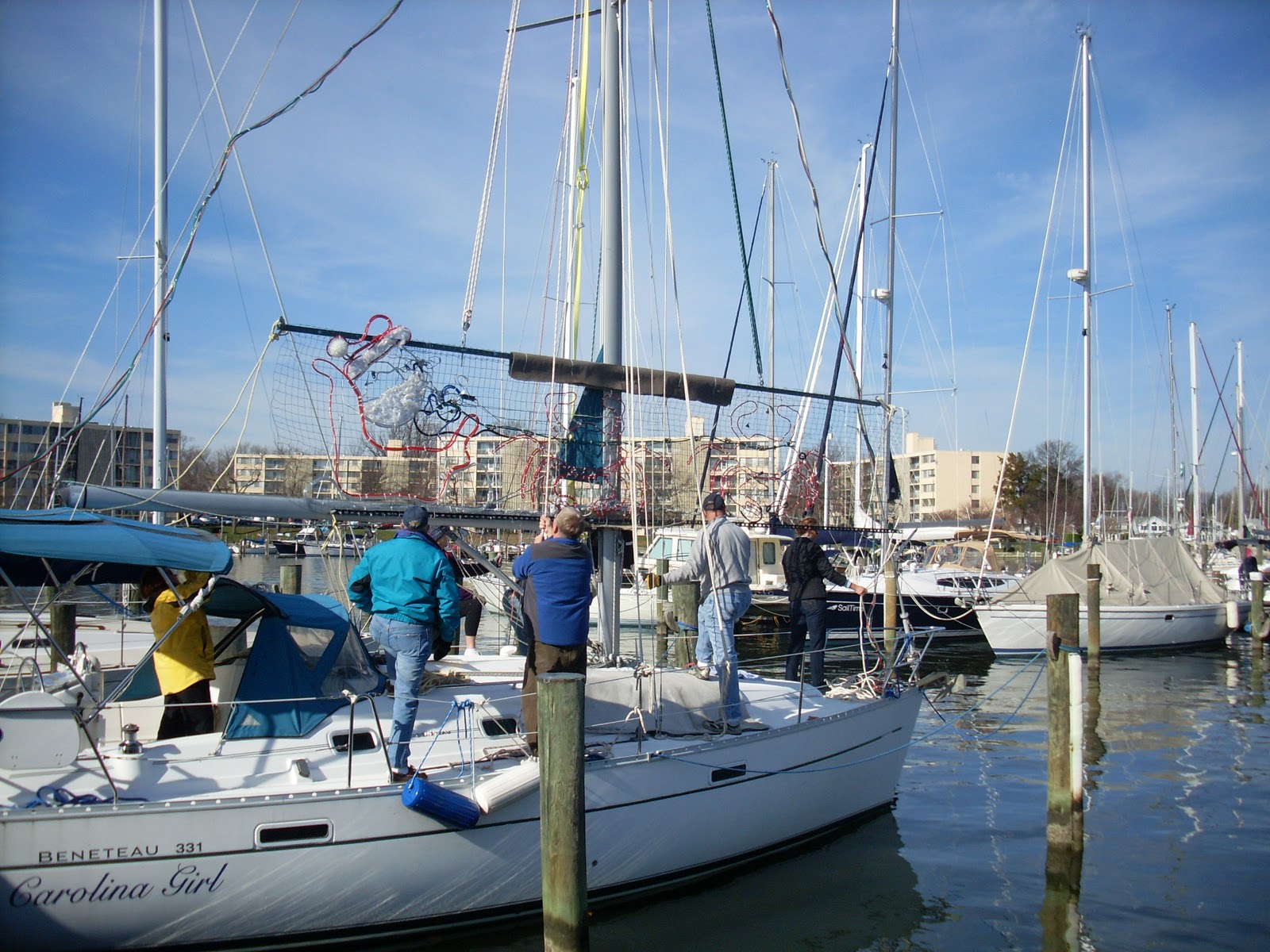
.. and it takes a few hands to sort out the rigging………..

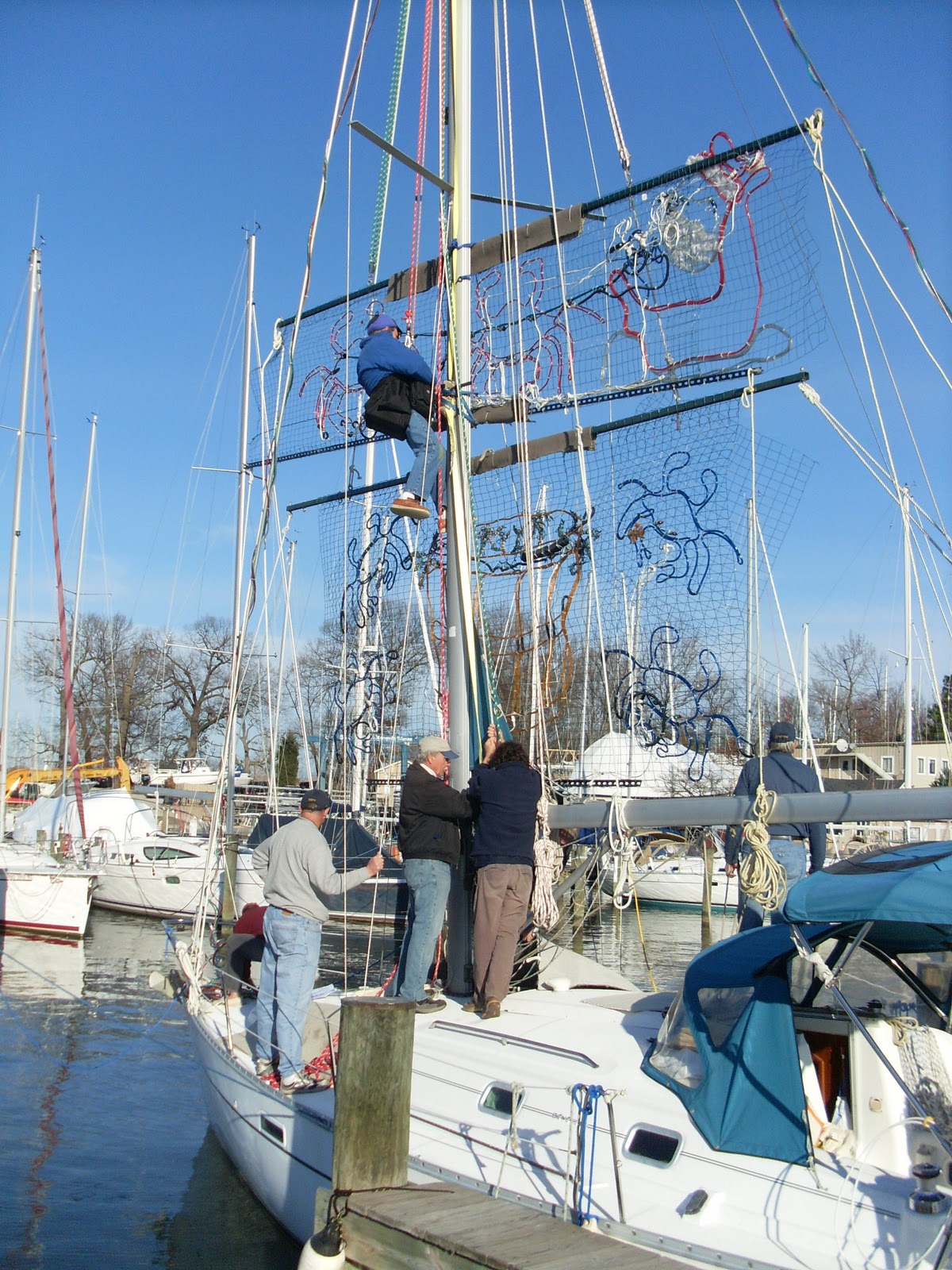
It’s a neattrick to get it all up a 50ft mast in the right orientation and secured forwhen the boat is in motion!

Then all the wiring connections must be made and labled so the various sections of the display find the right settings on the control panel ………

We even hauled a news photographer up the mast in the bosun’s chair to help him get some good pictures!

Here’s a short clip of some of the perparations ….

http://www.youtube.com/get_player

We think this year’s entry is boundto garner support of the judges!!

SOS boat pix …

Some other boats …………..

Happy Holidays!

Winter’s coming………..

Although the cruise south to warmer weather got postponed to next year, being an optimist by nature, the final steps in winterizing are deferred till serious freeze warning are issued. That said, the process got underway this past weekend. Except for cushions, all the fabric materials came off the boat, as well as all the non-dried food supplies. Battery levels were checked, antifreeze was pumped through the fresh water system, and a heater set up for possible chilly nights on board. Bimini and dodger are home for cleaning and repairs.
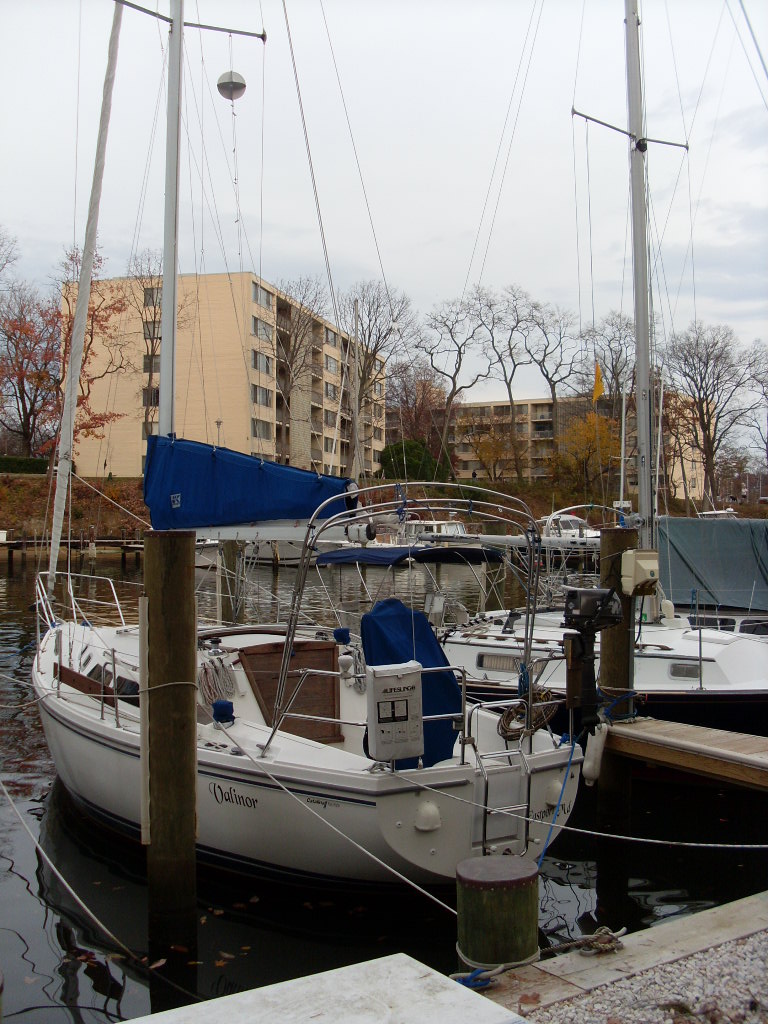
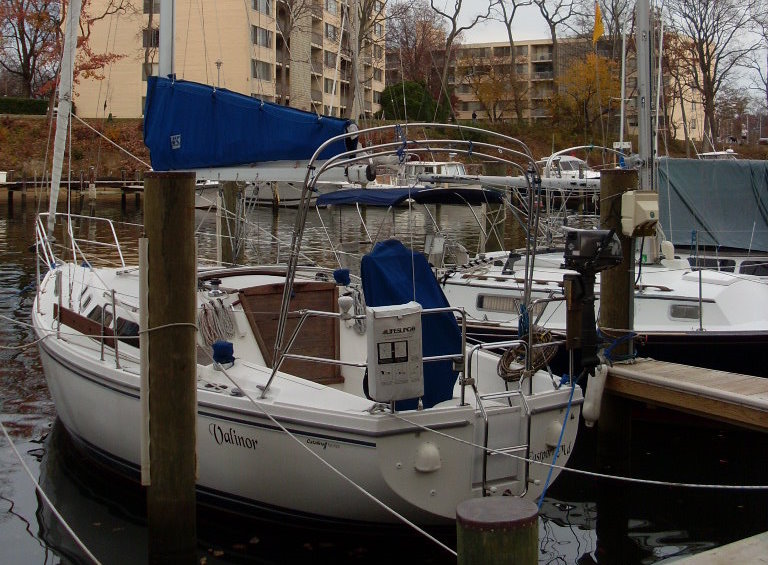
To make access easier for when the tarp goes on to cover the cockpit, Valinor is now in her slip stern first.


Water depth is a concern in this slip, but it measured 4.3′ at low tide leaving about 6″ of clearance. Likely she will rest on the bottom at an occassional very low tide. 

When all prospects for sailing are gone, sails and cushions will come off and brought home to clean for next season.

Each year the SOS club decorates a boat for the Annapolis ‘Parade of Lights’. They do a very professional job and always have an imaginative design. I got a ride on the Parade boat a couple years ago, and signed up for the work crew this year. So Sunday afternoon was spent hauling supplies from storage, cleaning up from last winter’s work and begining the process of putting together this year’s light deisgn. Lots left to do, but it looks to be another great boat!  Pictures later…….

Looking forward to next season, I spent a half day attending a weather seminar presented by the Bermuda Ocean Race committee. Early preparation for those who plan to particpate (or might). The instructors were professional meterologists from the Naval Academy. Lots of good information! Finally learned how to interpret the 500mb chartsThe BOR starts just off Annapolis, goes down the Bay then off shore to Bermuda – start date is 8 June 2012.


A Work in Progress

As this season comes to an end,  I’m taking stock of past improvements and consideringplans as I  look forward to next season……..

Everyone who owns, or has ever owned, a boat knows it isalways a work in progress! Some is simple maintenance, some major ‘renewal’ ofcritical components or repairs, but some is investment to improve comfort,performance or safety.

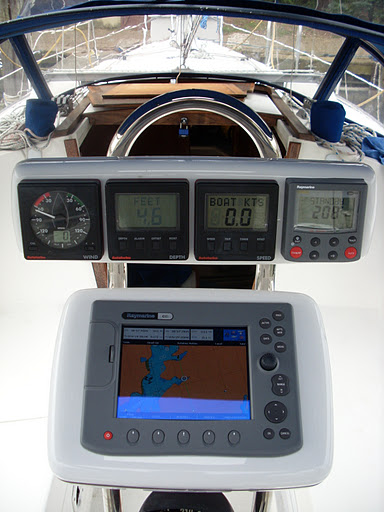
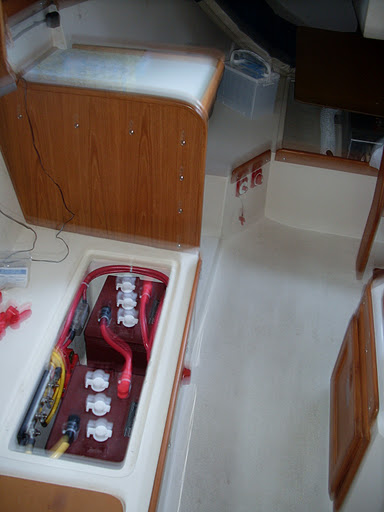
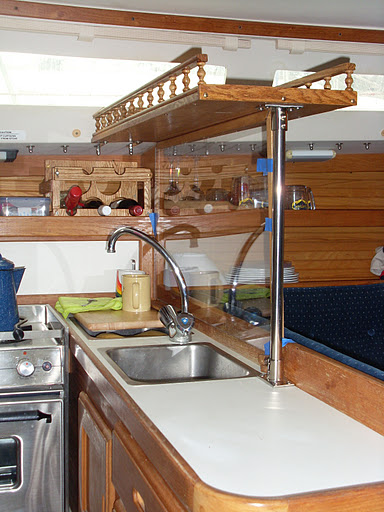
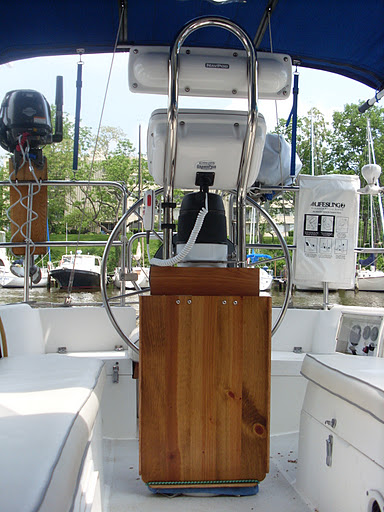
Now in the 4th year with Valinor, we’ve donemost of what was on the ‘LIST” …… rebuilt the helm, upgraded the battery system,improved galley storage, added a cockpit table and stern seats, and replacedthe Dutchman with a new UK Lazy Cradle system (with sail modifications for aloose-footed main).  We added 30 morefeet of chain to the anchor rode providing 60ft of chain and another 90ft ofrode with a Danforth and small plow riding on the bow.
Helm – Like dominos,one decision leads to a whole series J 
I decided to add a C80 chart plotter to thehelm – and later a wheel pilot.  To makeroom and accommodate the new wiring, the old single, straight 1” guard was replaced witha new 1 1/4” double bend guard and two new instrument pods to provide for theplotter and the X5 wheel pilot control. The old, cranky windex system has also been replaced.
These changes made single-handing simpler, and with a newDSC radio and RAM at the helm, much improved safety.
Batteries – More electronicsand longer cruises placed greater demands on my single, limited 12V housebattery.  The standard two 12v batteriesand switching were replaced with two 6V in series for the house bank and astandalone 12V starter controlled in such a way that only a dead starter wouldrequire connecting to the house bank. Upgraded to a new 20A Xantrex charger. This season we added a Xantrex batterymonitor to track usage and provide real-time information on battery state ofcharge. These changes raised the house capacity from 80ah to about 180ah,and the related changes in wiring (heavier gauge and shorter run) greatly improved starting power.
Galley – Any 30ftboat is limited in storage space.  A criticalimprovement was the addition of a small wine rack J.
Also, an over-the-sink shelfadded greatly to convenient storage. Including a plexiglass panel protected thesalon cushion from spray from the sink.
                  

Cockpit (table andstern seats) – Finding so much time spent on deck, a cockpit table wasessential.

After choking down the cost of a ‘convenience’ like the stern seats,we’ve come to appreciate that nicety, and wondered why not sooner.

With plans in the works for longer cruising, energy storageis rising up the otherwise shortening list. Either generator or solar seems the bestsolution, but will have to wait. As will cabin heat, either propane or diesel. Trying not to think about replacements:  sails, canvass, standing rigging, or theaddition of an asymmetric drifter.  
So, I guess it only ends when the boat is sold, or when timeruns out …….

End of the season chill…….

Always a sad day when we come to the end of the season.

The weekend turned out pretty nice (given days at about 50F and the night around 40F) with plenty of sunshine.  Saturday winds were nicely behind us at 8-10kts most of the way south to Galesville. Made for a pleasant, and quick ride down at 5.5 – 6kts under head sail alone. We tucked into a smallish slip, hooked up shore power and turned on the cabin heaterJ

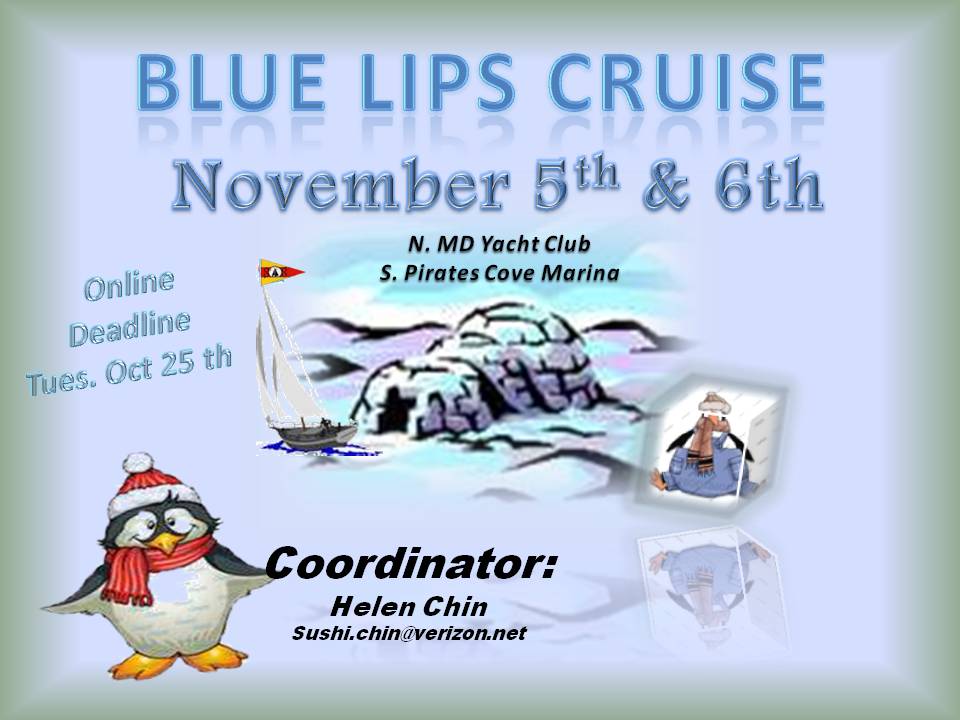
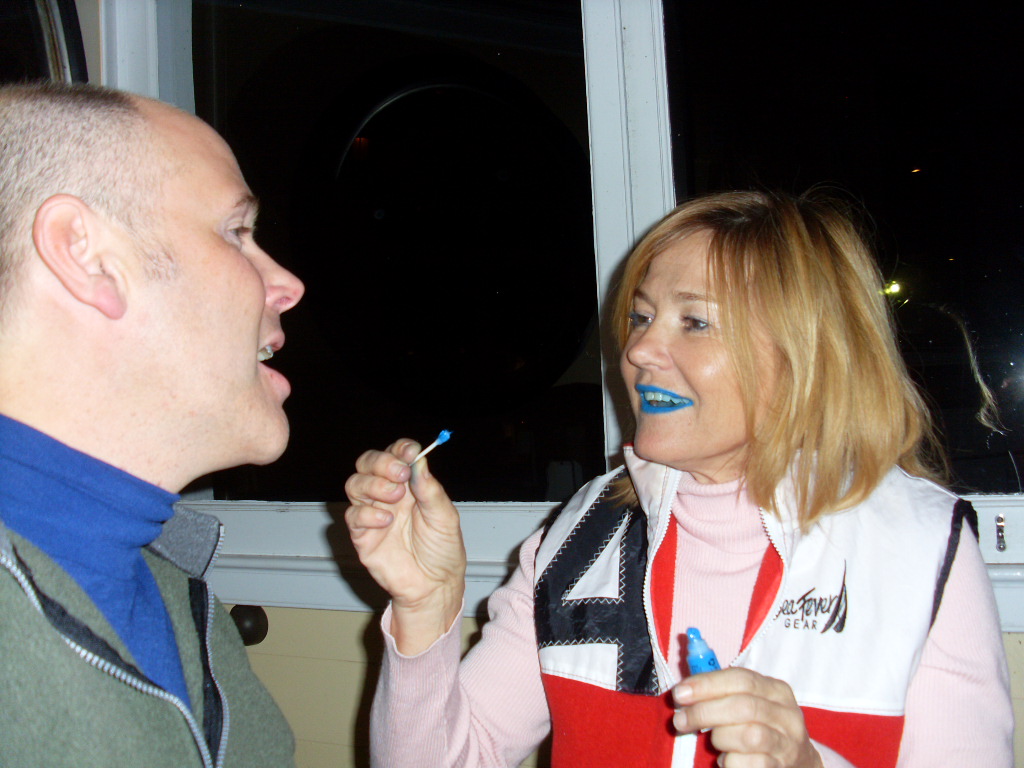
The Blue Lips party lived up to its name

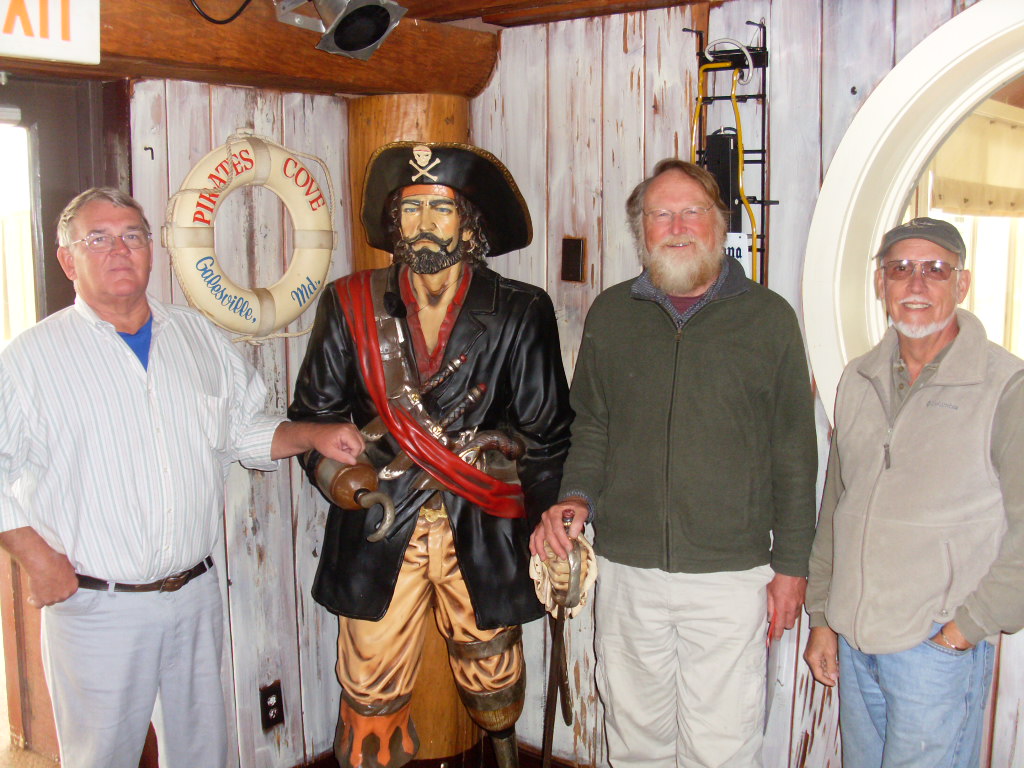
As a bonus treat, we got to meet and visit with a sailing friend from Maine on his way south. Roger (just right of ‘Hook’) is a retired naval architect whose credentials include the research vessel Rachel Carsonoperated by the U of MD lab at Solomons. SOS friend Ron (left) and I know Roger from the Sailboatowners forum and appreciated the chance to meet in person..

The guy with the hook was a stranger …….

We got a little lift from the mainsail on the way back home into light NE wind — all in all a great end of the season cruise!

It’s the little things…

 ….. that remind us of coming changes. It’s the momentarychill that blows across the water on an otherwise warm, sunny day. It’s thatfirst slate gray sky. Pumpkins appear in the fields and birds flock withapparent purpose and orientation. Leaves change color first then cover theground on increasingly blustery days. Ever notice how easily we put on weightwhen the days begin to shorten – in apparent preparation for less pleasantweather?  Perhaps we were hibernators inour distant past?

Each hint by itself might go unnoticed, collectively theyare ominous.

 The little note on the calendar or in our log says it’snearing time to ‘winterize’ – what an ugly word. Those of us who can’t be headingsouth say a temporary ‘good bye’ to friends who are. It’s that trip to thestore for antifreeze, arrangements to get sails down and cleaned and stored;finding the cover tarp and emptying the cabin of those supplies and furnishingsthat don’t winter well.

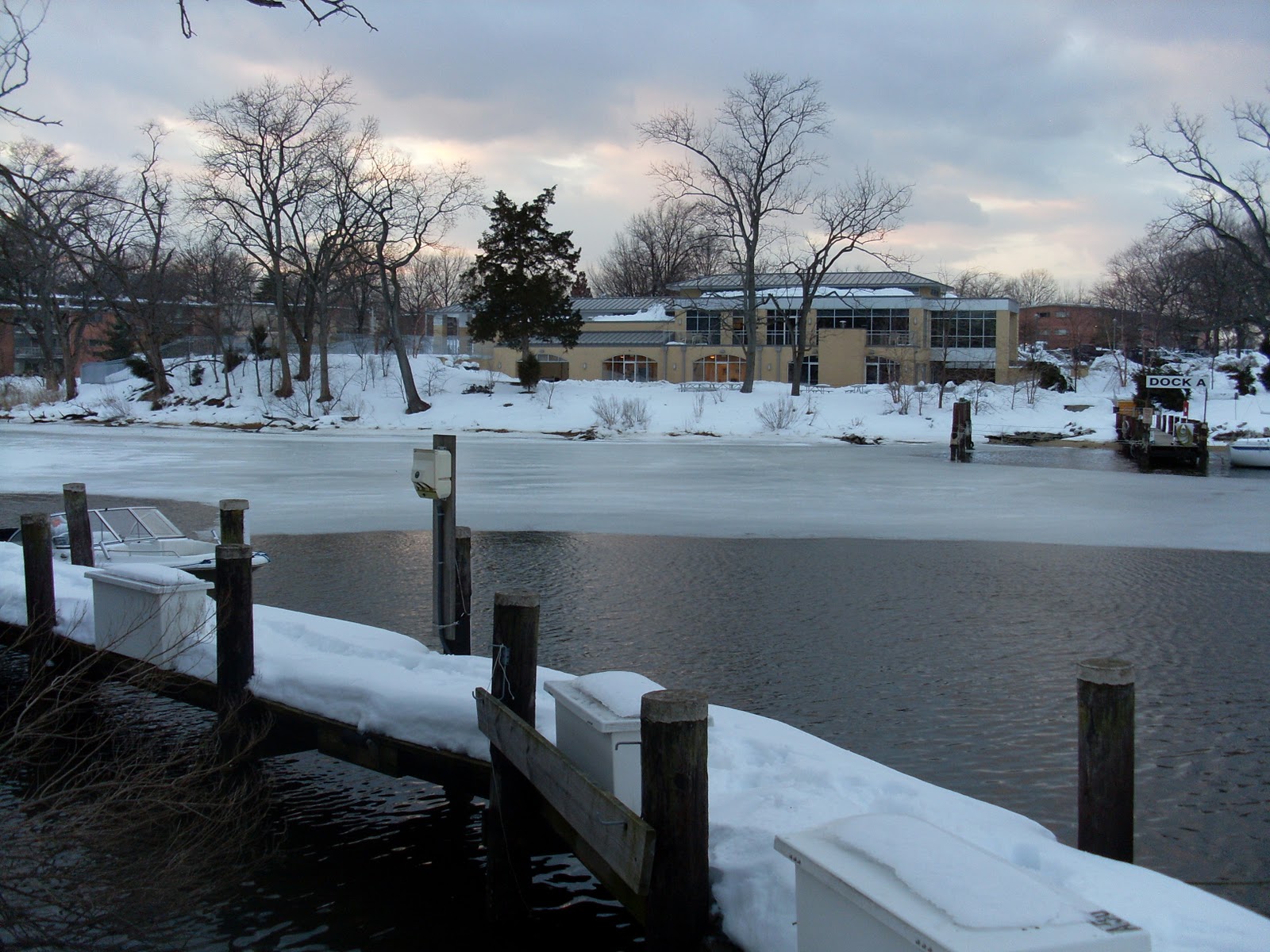
 Finding time on the water becomes more compelling. A senseof urgency takes over. Quick, get to the boat and grab that 10-15kt day beforethe bite of winter and the spray of icy water turns fun into challenge. Blockedon the hard or isolated in an ice-bound harbor with the bubbler running in theslip will soon foreclose that option — for a time.

 Reviewing the season’s log,beginning to plan for the new sail, repairs and upgrades, and a long weekend atthe boat show are also hints of the impending down time, but also offerhope.  Spring is, after all, just aroundthe corner! The off-season gives us the chance to recall why we missed thatmark or made the start line a second too soon. We can imagine exactly how wewill fix that next season. It’s sitting in a warm place with sailing friends lookingforward to more proper weather that is only a few short months away. I for oneprefer to imagine a season of prefect weather, precisely timed starts, excitingfinishes and long passages with great sailing friends. Winter is only a minorpause in the important stuff of life….